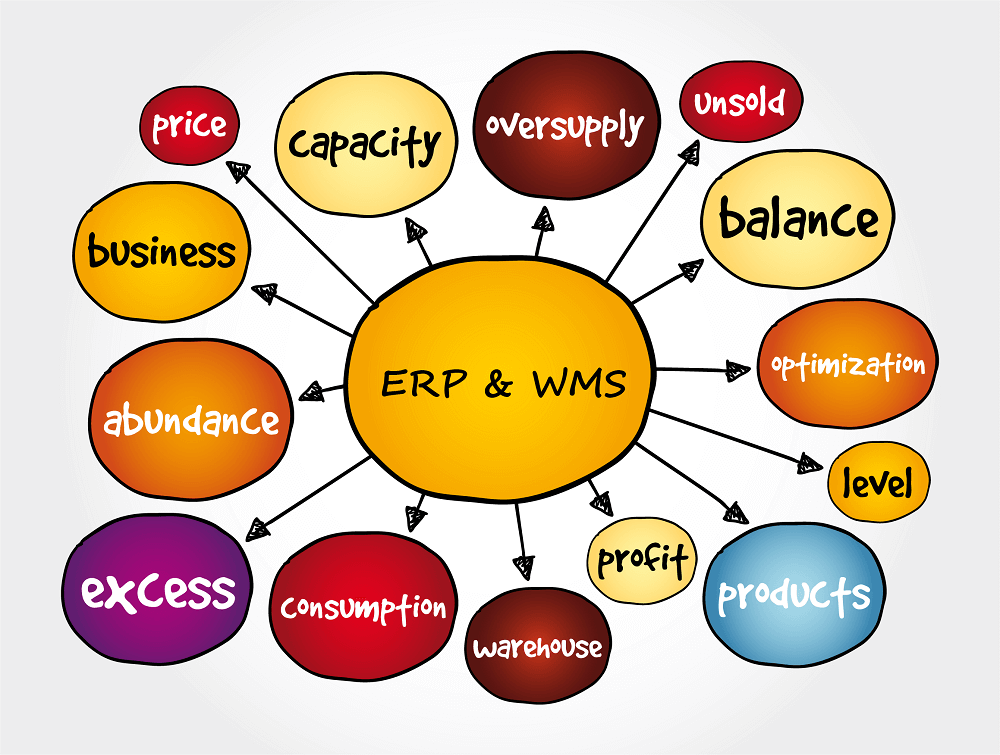
What is the Difference Between ERP and WMS?
As a business grows, its supply chain and distribution network typically grow and become more complex to match. Effective management requires labor optimization, automation, and operational flexibility to forecast and adapt to fluctuations. This is the stage in a company’s development when an enterprise resource planning (ERP) system or a warehouse management system (WMS) is often implemented. But what is the difference between ERP and WMS?
Ideally, the two are integrated together for optimal value.
Why would you want to use both types of systems, and what is the difference between ERP and WMS? At a basic level, ERP provides visibility in supply chain management, automates tasks and operations, and delivers critical business intelligence. But it doesn’t trace every last detail of warehouse management.
For this reason, ERP and WMS are integrated to gain more granular control of resources and inventory, both internally and externally. Think of ERP as the backbone for managing the supply chain, while WMS brings the advanced functionality needed to take efficiency and productivity to the next level.
A Closer Look at WMS
Many manufacturers and distributors choose to implement a standalone WMS system to manage workers, inventory, and resource balancing.
Several benefits make this an attractive solution. Inventory management helps businesses keep a more appropriate balance of stock to prevent waste. Logistics handling, picking strategies, shipping integration, embedded label printing, and out-of-the-box performance analytics are other key features in a warehouse operation.
A WMS platform can automatically monitor and analyze activity to optimize processes and tasks, reducing operating expenditures and gaining more productivity, and ultimately saving time and money by reducing waste. Safety and security are enhanced because of improved inventory metrics and labor movement in the warehouse, reducing risks of accidents and injury while also preventing theft and inventory shrinkage.
Furthermore, a WMS system can foster stronger relationships with suppliers and customers, as WMS can lead to more efficient communications and delivery.
ERP in Supply Chain Management and Beyond
ERP in supply chain management helps, but most businesses need to focus on streamlining operations well beyond the supply chain and use insights from all areas of the business to make strategic decisions for future growth. An ERP system automates data collection and integrates it not just from the manufacturing floor and the supply chain, but also from accounting, HR, project management, order processing, and customer service and relationship management.
Visibility and transparency throughout the business are critical for success and profitability, and ERP provides these key advantages. Many ERP systems have WMS modules that can do much of what a standalone WMS solution can do, and ERP solutions often can be integrated with standalone WMS systems. WMS capabilities can help extend ERP in supply chain management to all aspects of the warehouse for stronger organization and process streamlining—all while offering greater visibility into every area of the supply chain.
Rolling out an ERP system that provides all the features and functionality of a standalone WMS solution can optimize your supply chain management. Integrating an ERP system with a separate WMS platform can be an equally beneficial strategy, as long as the WMS solution is built for that and doesn’t require time-consuming or costly customization.
Either way, ERP in supply chain management is critical for growth-oriented businesses. The system promotes forward-thinking planning, as it can help anticipate fluctuations in product demand and supply needs, as well as potential bottlenecks and shortfalls. Strengthening responsiveness in the supply chain helps reduce risks and improve decision-making.
ERP also goes beyond the supply chain in ways that WMS does not. For example, an ERP system provides more integrated data analytics about each customer’s journey, showing the business aspects of customer trends. It also helps automate the journey from the warehouse—for example, a new order can prompt a credit check, then check product availability, update the distribution schedule, and send out an invoice.
How Long Does ERP Implementation Take?
One of the most common questions among businesses exploring ERP is “How long does ERP implementation take?”
ERP rollouts can be complex, particularly if you are dealing with system integrations and customizations. So how long does ERP implementation take ? The answer can range from a few months to a few years, depending on whether you are implementing a cloud or on-premise ERP.
A typical ERP system setup has dozens of system configurations, but you may not need all of them, or you may require specific customizations. The implementation process involves several phases, including planning/evaluation, configuration, customization, data conversion, any necessary integrations with other systems, testing, and training.
The goal is to eliminate silos by automating routine, repetitive tasks and getting a consolidated view of business and customer demands for greater efficiency. The supply chain is better managed because the ERP system provides real-time data on existing and incoming supplies, hours worked, and more, helping you find bottlenecks or waste.
Businesses have found that they can greatly reduce how long ERP implementation takes by using cloud-based ERP solutions, however, and by selecting pre-configured ERP solutions made for specific industry needs.
A Life Sciences Software Solution for Supply Chain Management
A supply chain can make or break a company’s promise of customer satisfaction. This is especially true for life sciences firms, which often have capable life science software but inadequate supply chain management systems in place. ERP solutions such as SAP Cloud ERP can complete the circle, connecting a business’ existing life science software with the robust supply chain management of a comprehensive ERP solution and a WMS for warehouse management.
Solutions such as SAP S/4HANA Cloud Public Edition can be used on their own or integrated with other powerful WMS solutions to provide efficiency and transparency that extends well into the supply chain.
The combination of a modern, cloud ERP system with a powerful, fully integrated WMS solution provides the visibility, automation, and efficiencies needed to ensure warehouses remain competitive, streamlined, and successful. It picks up where existing life science software leaves off.
Navigator has been helping growth-focused firms with ERP and supply chain management for more than a decade, and we’ve created prepackaged industry solutions for all types of industries, such as life sciences. If your life sciences business is struggling with supply chain management, check out our ERP life science software solution.